
A Scoping Review of Generative AI Usage and Human Cognition in Education and Professional Practice: Dual-Edged Cognitive Impacts and a Governance Framework
DOI:
https://doi.org/10.59120/drj.v17i3.615Keywords:
Generative Artificial Intelligence, Governance Framework, Higher Education, Human Cognition, Scoping ReviewAbstract
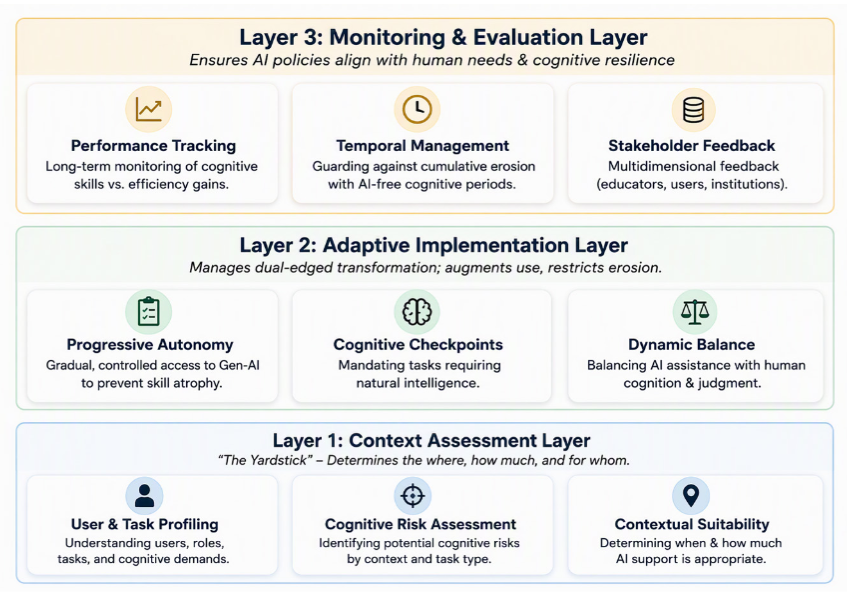
The use of Generative Artificial Intelligence (Gen-AI) across education, healthcare, ethics, and professional practice is rapidly increasing. This growth has sparked a polarized debate, with Gen-AI viewed either as a powerful cognitive augmenter or as a potential threat to critical thinking, creativity, and independent reasoning. To examine this issue, the review scope was defined using the PRISMA-ScR guidelines, Joanna Briggs Institute (JBI) methodology, and the Population–Concept–Context (PCC) framework. A systematic literature search was conducted across PubMed, IEEE Xplore, ACM Digital Library, Springer, and Wiley Online Library. Only English-language publications published between 2020 and 2025 were considered. Following multi-stage screening, duplicate removal, eligibility assessment, and human verification, 107 peer-reviewed articles were included in the final analysis. Among the selected studies, 42% focused on university education, 23% on school education, 16% on medical education, 11% on ethics and moral responsibilities, and 8% on professional training. Synthesis of the findings led to two major conceptual contributions. First, the Cognitive Impact Taxonomy (CIT) provides a structured approach for assessing Gen-AI’s influence on fluid and crystallized intelligence, key cognitive processes, and the trajectory of cognitive impacts leading to severity assessment. Second, the Integrated Cognitive Symbiosis Framework (ICSF) introduces a three-layer governance model to support responsible and cognitively healthy Gen-AI adoption. Together, the CIT–ICSF pipeline offers educators, institutional leaders, and policymakers a practical mechanism to maximize the benefits of Gen-AI while mitigating potential long-term cognitive risks.
Downloads
References
Adnin, R., Pandkar, A., Yao, B., Wang, D., and Das, M. (2025) Examining student and teacher perspectives on undisclosed use of generative AI in academic work. In: Proceedings of the 2025 CHI Conference on Human Factors in Computing Systems, pp 1–17. ACM, New York, NY, USA. https://doi.org/10.1145/3706598.3713393
Al-Abri, A. (2025). Exploring ChatGPT as a virtual tutor: A multi-dimensional analysis of large language models in academic support. Education and Information Technologies, 30(12), 17447-17482.https://doi.org/10.1007/s10639-025-13484-x
Alabsi, H., Almotairi, M., Alyami, M., Alqahtani, Y., Obeidat, R., and Almansour, F. (2025) Can ChatGPT serve as a cognitive stimulus? A proposed model for assessing the impact on graduate students' perceptions of cognitive and developmental skills. In: Advances in Intelligent Systems and Computing, 461–468. Springer Nature Switzerland, Cham
Alaswad, S., Kalganova, T., and Awad, W. (2025). Developing a Framework for Using Large Language Models for Viva Assessments in Higher Education. In 2024 International Conference on IT Innovation and Knowledge Discovery (ITIKD) (pp. 1-7). IEEE. https://doi.org/10.1109/ITIKD63574.2025.11005250.
Downloads
Published
Issue
Section

License
Copyright (c) 2026 Kaneeka Vidanage, Manith Marapperuma, Shakya Dissanayake, Faiz Mohideen Mohamed Thassim Marikar

This work is licensed under a Creative Commons Attribution-NonCommercial 4.0 International License.
DRJ is an open-access journal and the article's license is CC-BY-NC. This license allows others to distribute, remix, tweak, and build on the author's work, as long as they give credit to the original work. Authors retain the copyright and grant the journal/publisher non-exclusive publishing rights with the work simultaneously licensed under a https://creativecommons.org/licenses/by-nc/4.0/.