

Life History and Predatory Behavior of Euborellia annulata (Dermaptera: Anisolabididae) on Papaya Mealybug (Paracoccus marginatus)
DOI:
https://doi.org/10.59120/drj.v17i3.599Keywords:
Biological control, earwig, insect pest management, insect predator, predator-prey interactionAbstract
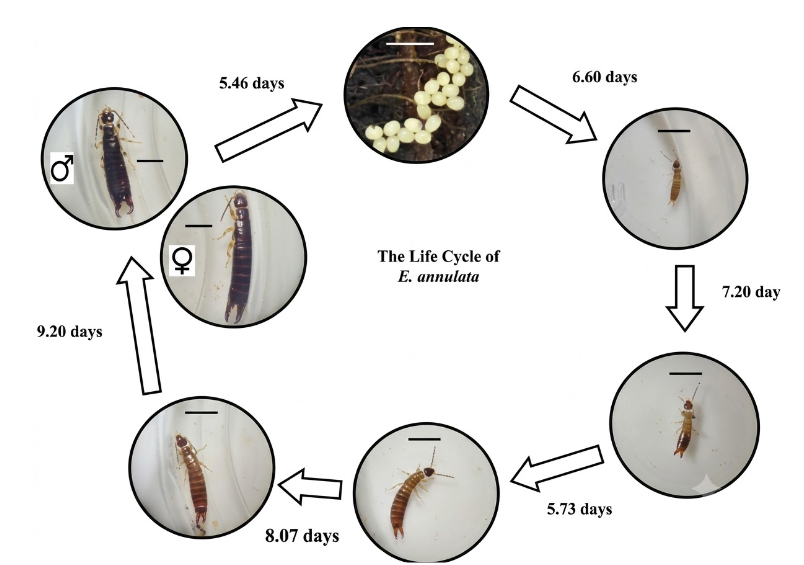
This paper reports the life history of Euborellia annulata (Fabricius) and its predatory behavior against the papaya mealybug, Paracoccus marginatus Williams and Granara de Willink, under laboratory conditions (25 ± 2°C and 70 ± 5% RH). Ten second generation adult pairs of E. annulata were allowed to mate, oviposit, and complete their development while feeding exclusively on P. marginatus. The setup was arranged in a Completely Randomized Design (CRD) with three biological replicates. Results indicate that mating to oviposition occurred after a short pre-oviposition period of 5.46 days, while egg incubation was completed approximately 6-8 days. E. annulata underwent four nymphal instars before reaching adulthood. The first lasted 7.20 days, while the second instar lasted 5.73 days. Third required 8.07 days before transitioning to the fourth and final nymphal stage. The fourth exhibited the longest developmental duration of 9.20 days. Adults were characterized by a smooth, glossy black exoskeleton. Sexual dimorphism was evident through differences in cercal morphology. Predation involved prey assessment and repeated attempts at attack before successful capture and consumption. An individual earwig required 30–40 minutes to consume a single mealybug nymph. This, however, suggests relatively high prey-handling costs which might be associated with overcoming the waxy defenses of P. marginatus. Although the predator readily accepted and consumed the mealybug, prolonged handling time may constrain its maximum predation rate under high pest densities. Further studies are needed to evaluate the functional response, habitat overlap with arboreal pests, and field-level efficacy within integrated pest management programs.
Downloads
References
Adnan, A. M., and Taufik, M. (2010). Earwig (Euborellia annulata) as the promising biological control agent against asian corn borer. In: Zaidi, PH; Azrai, M. and Pixley, KV, eds., Maize for Asia: Emerging Trends and Technologies. Proceedings of The 10th Asian Regional Maize Workshop, Makassar, Indonesia, 20-23 October 2008. Mexico DF: CIMMYT (p. 442).
Asmanizar, Waridha, A., Simbolon, F. M., and Sumantri, E. (2023). Exploration of Spodoptera frugiperda natural enemies on Zea mays cultivation area. IOP Conference Series: Earth and Environmental Science, 1241,1, 012018. IOP Publishing. https://doi.org/10.1088/1755-1315/1241/1/012018
Bischoff, R., Pokharel, P., Miedtke, P., Piepho, H. P., and Petschenka, G. (2024). Environmental complexity and predator density mediate a stable earwig-woolly apple aphid interaction. Basic and Applied Ecology, 74, 108-114. https://doi.org/10.1016/j.baae.2023.12.003
Downloads
Published
Issue
Section

License
Copyright (c) 2026 Karl Fritze S. Sampiano

This work is licensed under a Creative Commons Attribution-NonCommercial 4.0 International License.
DRJ is an open-access journal and the article's license is CC-BY-NC. This license allows others to distribute, remix, tweak, and build on the author's work, as long as they give credit to the original work. Authors retain the copyright and grant the journal/publisher non-exclusive publishing rights with the work simultaneously licensed under a https://creativecommons.org/licenses/by-nc/4.0/.