

Perceptions, Causes, and Socioeconomic Effects of Drowning in Artisanal Fishing Communities
DOI:
https://doi.org/10.59120/drj.v17i1.516Keywords:
Artisanal fisheries, Inland, Ghana, Marine, Occupational safetyAbstract
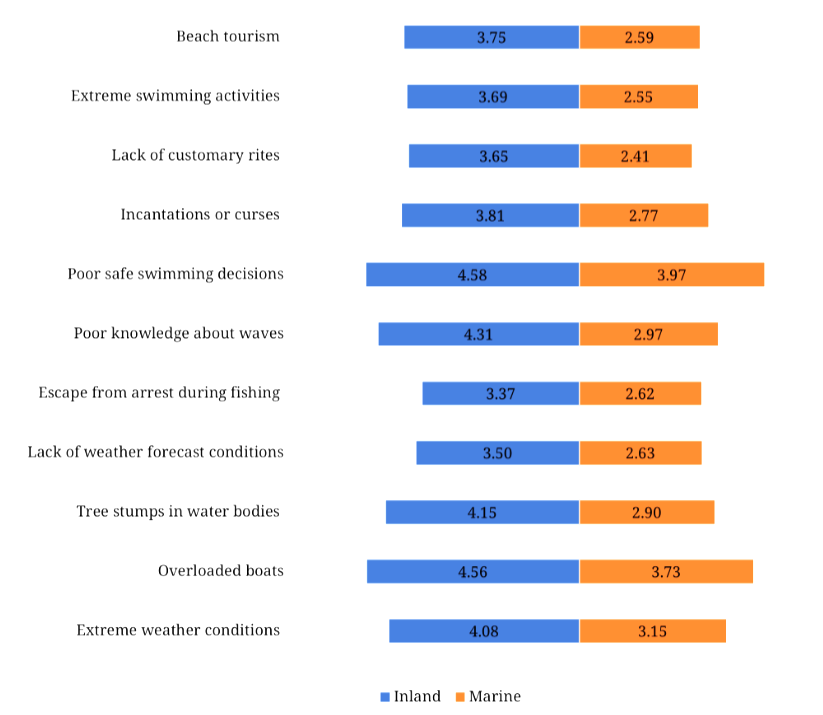
Drowning is an under-recognized occupational hazard in Ghana's marine and inland fishing communities. This study examined the perceptions, causes, and effects of drowning in these sectors through a cross-sectional survey of 151 respondents, utilizing structured questionnaires with a 5-point Likert scale. Data were analyzed using descriptive statistics, independent sample t-test, Mann-Whitney U-test, Kruskal-Wallis test, and One-Way ANOVA. The results indicated that perceptions and causes of drowning were significantly higher in inland fisheries (MSP = 3.2 ± 0.2; MSC = 4.1 ± 0.1) compared to marine fisheries (MSP = 2.7 ± 0.1; MSC = 3.6 ± 0.2) (Mann-Whitney U-test, p < 0.05). In the marine fisheries, the primary causes of drowning were poor swimming decisions (MSC = 3.49), overloaded boats (MSC = 3.73), and extreme weather conditions (MSC = 3.15). Conversely, in inland fisheries, the significant causes were poor swimming decisions (MS = 4.58), overloaded boats (MSC = 4.56), poor knowledge of wave patterns (MSC = 4.31), submerged tree stumps (MSC = 4.15), and extreme weather conditions (MSC = 4.08). Regarding the effects of drowning, the main effects of drowning from both inland and marine fisheries were death (MSinland = 4.63 and MSmarine = 4.08) and financial stress (MSinland = 4.31 and MSmarine = 3.51). Based on these findings, it is recommended that fisheries-specific strategies, including awareness programs and infrastructure development, such as tree stump removal, be urgently implemented to reduce drowning incidents in Ghanaian fishing communities.
Downloads
References
Adepoju, O. O. (2022). Excess load on ships and its effects on stability performance in Nigerian waterways. Journal of Sustainable Development of Transport and Logistics, 7(1), 62-72. https://doi.org/10.14254/jsdtl.2022.7-1.5
Adjei, J. K., and Sika-Bright, S. (2019). Traditional beliefs and sea fishing in selected coastal communities in the Western Region of Ghana. Ghana Journal of Geography, 11(1), 1-19. https://doi.org/10.4314/gjg.v11i1.
Agodzo, S. K., Bessah, E., and Nyatuame, M. (2023). A review of the water resources of Ghana in a changing climate and anthropogenic stresses. Frontiers in Water, 4, 973825. https://doi.org/10.3389/frwa.2022.973825
Downloads
Published
Issue
Section

License
Copyright (c) 2026 Samuel K.K. Amponsah, Gibert Baah

This work is licensed under a Creative Commons Attribution-NonCommercial 4.0 International License.
DRJ is an open-access journal and the article's license is CC-BY-NC. This license allows others to distribute, remix, tweak, and build on the author's work, as long as they give credit to the original work. Authors retain the copyright and grant the journal/publisher non-exclusive publishing rights with the work simultaneously licensed under a https://creativecommons.org/licenses/by-nc/4.0/.